

The Ultimate Guide to ChatGPT Ads
I have spent the last year watching the ChatGPT ecosystem move from novelty to daily habit. That habit is now big enough that monetization is no longer a theory. OpenAI has said it plainly: ads are coming, and they are coming to expand access, not to rewrite the product.
My thesis is simple: ChatGPT ads will be the most constrained ad product in paid media, and that constraint will be the opportunity. The separation between the answer and the ad is not a detail. It is the feature. It forces advertisers to earn relevance inside a conversation rather than buy it through interruption.
OpenAI's statement is the clearest signal yet that the ad era for chatbots is real. If you are an advertiser, this is the window to prepare before the new inventory goes live.

What OpenAI actually said
OpenAI's announcement is not a vague roadmap. It sets explicit boundaries for how ads will show up and what will never change. The key points I took away were:
- Ads are planned to start testing in the U.S. for the free and Go tiers in the coming weeks.
- Pro, Business, and Enterprise tiers will stay ad-free.
- Ads will not influence the answers ChatGPT gives you, and ads will be clearly labeled and separated from the organic response.
- Conversations are private and not sold to advertisers.
- Users can turn off ad personalization and clear ad-related data.
- Early tests will avoid showing ads to under-18 users and will avoid sensitive or regulated topics.
That is a strong set of guardrails. It also tells you exactly where the ad real estate will live: below the answer, not inside it.
Why ads are arriving now
OpenAI has already won the daily habit battle. The question is not whether people will use ChatGPT. The question is how to make that access sustainable and global.
The announcement explicitly connects ads to access: the free and low-cost Go tier exist to make advanced AI available to more people, and ads are the funding mechanism for that expansion. In other words, ads are not a pivot away from the mission. They are being framed as the mechanism that keeps the mission affordable.
That framing matters because it will shape how the ad product is designed. If the goal is access, then the product must protect trust. That leads to the next section.
The non-negotiables that will shape every ad format
OpenAI laid out principles that I believe will define the ChatGPT ads ecosystem. These are not marketing lines. They are operational constraints that will limit what advertisers can do, and they will also elevate the brands that play well inside them.
- Answer independence: ads do not influence the answers. The model is optimized for helpfulness, not spend.
- Conversation privacy: conversations are private and not sold to advertisers.
- Choice and control: users can turn off personalization and clear ad data; an ad-free option remains.
- Long-term value: OpenAI says it will not optimize for time spent, prioritizing user trust over revenue.
If you are used to bidding for attention, this is a new playing field. You will be bidding for relevance inside a system that explicitly refuses to let ads rewrite the answer.
How ads will actually show up in ChatGPT
The first format is simple: a clearly labeled sponsored product or service at the bottom of a response, when relevant to the conversation. This is not a banner, and it is not a mid-conversation interruption. It is closer to a recommendation card placed in a dedicated ad slot that is visually separated from the response.
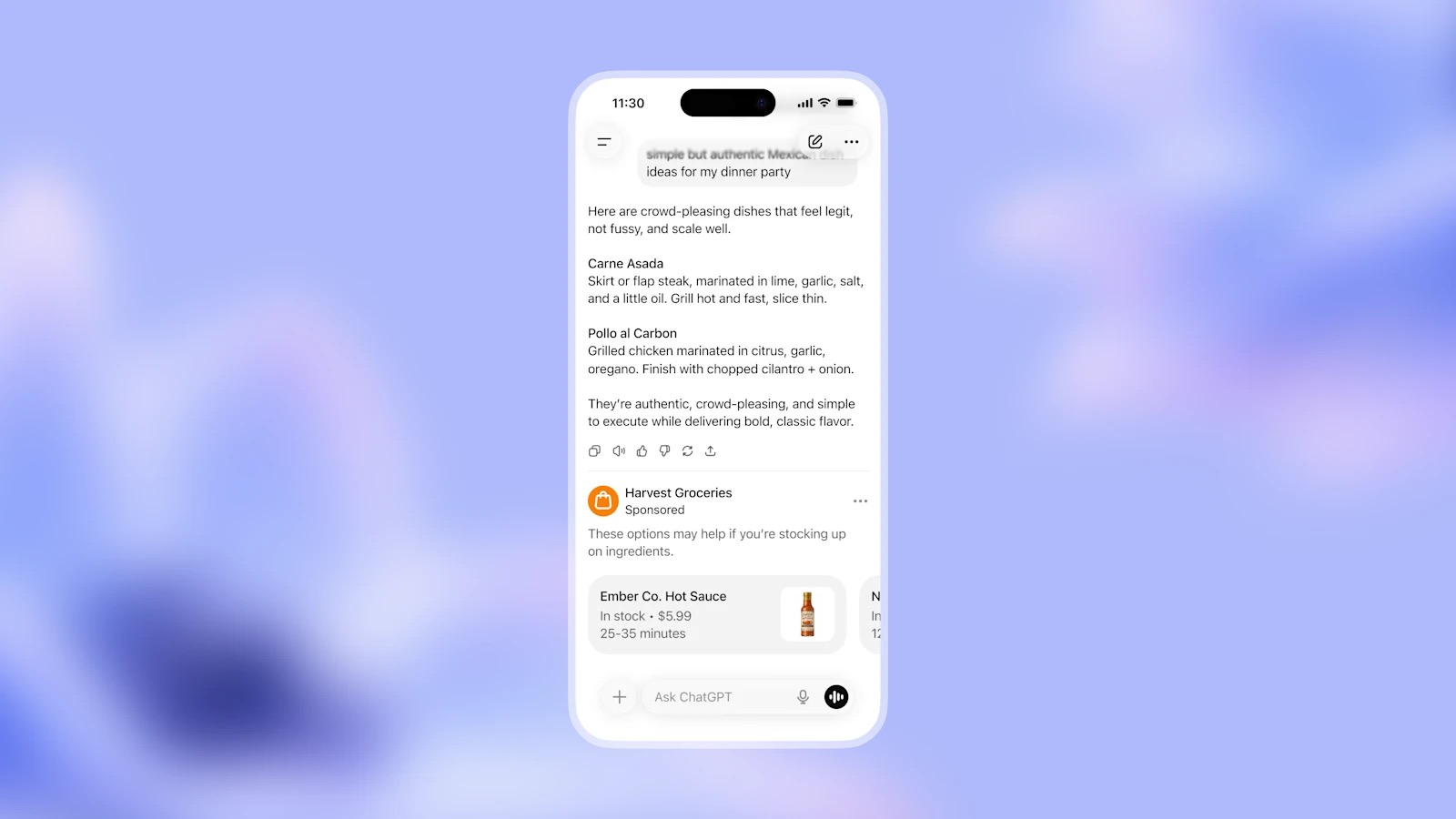
Source: OpenAI, Our approach to advertising and expanding access.
The initial test parameters are just as important as the placement:
- Geography: U.S. only at launch.
- Audience: logged-in adults; no ads for under-18 users.
- Topic sensitivity: no ads near health, mental health, politics, or other regulated topics.
- Controls: the user can dismiss an ad and see why they are seeing it.
For advertisers, this means the early inventory is intentionally narrow and brand-safe. You will need to target high-intent, non-sensitive contexts and be prepared to explain why your brand is the right answer-adjacent choice.

What this means for advertisers: the unit of intent has changed
In search ads, the unit of intent is a keyword. In chatbot ads, the unit of intent is a conversation state.
This changes everything:
- You do not just match a query; you match a narrative.
- You are not bidding on a phrase; you are bidding on a moment of need.
- The ad is not a distraction; it is an optional continuation.
The outcome is a new success metric. Click-through rate still matters, but the real KPI becomes conversation continuation and answer alignment. Your ad must feel like a helpful next step, not a side channel.
How to prepare before the ad platform opens
This is where Nexad comes in. Nexad is the world's 1st ChatGPT ads agency, and we have been preparing for this shift long before the announcement. Our approach is not just to buy inventory. It is to engineer relevance inside the conversation.
Here is the preparation checklist we give every brand:
- Map conversation intents. Identify the actual user questions that precede a purchase, not just the keywords that follow it.
- Build proof assets. Chatbots reward sources that can be summarized cleanly: spec sheets, comparison pages, and concise proof points.
- Create a product feed that LLMs can understand. Structured data matters more than ever, because the model has to explain your offer clearly.
- Design for "answer adjacency." The creative must make sense below a response, not as a standalone billboard.
- Plan for policy friction. Sensitive topics and underage audiences are off-limits. Know your safe contexts now.
- Define new measurement. Track downstream conversions, but also track conversation quality and how often your ad is saved, dismissed, or explored.
- Prepare a paid + organic playbook. Organic presence and paid placement will converge. If your brand is not credible in the answer, your ads will feel out of place.
This is a different operating system for growth. If you wait for the ad platform to launch before you build the assets, you will be late.
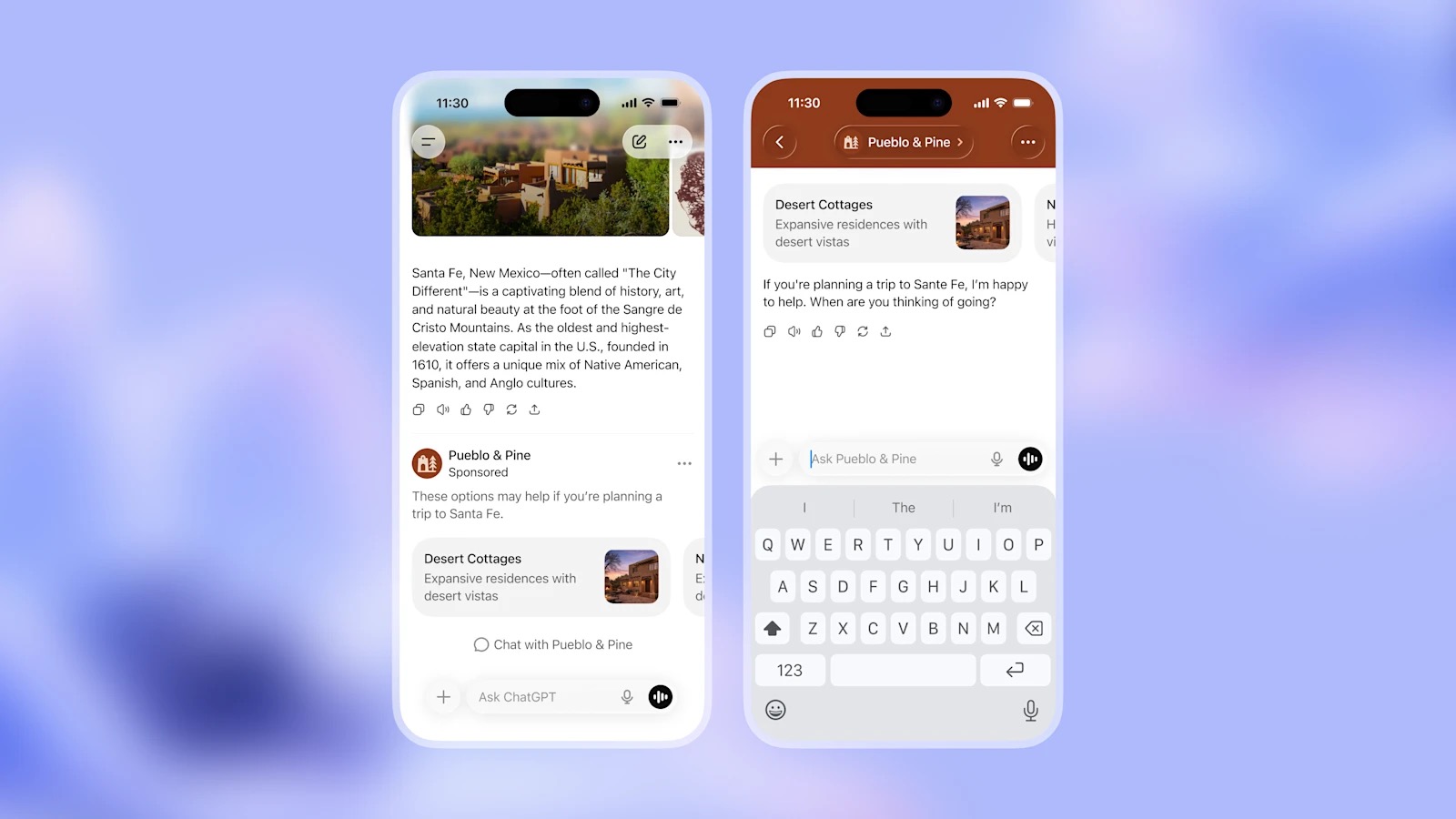
Source: OpenAI, Our approach to advertising and expanding access.
The wider wave: Claude, Gemini, and everyone else
OpenAI is not the only platform facing the cost of scale. Claude, Gemini, Perplexity, and Copilot all sit on the same economic curve. If ChatGPT can create a trusted, well-labeled ad experience without damaging the core product, others will follow.
I expect a familiar pattern:
- Free tiers will introduce ads to expand access.
- Paid tiers will protect a premium, ad-free experience.
- Early formats will be conservative and brand-safe.
- Over time, ads will evolve from static cards into interactive conversations.
The difference this time is that trust is not optional. In classic paid media, you could win by bidding higher. In chatbot ads, you win by being credible inside the conversation.
Chatbot ads vs traditional paid media
Below is the simplest way I explain the shift to founders and marketing teams.
| Dimension | Traditional paid media | Chatbot ads |
|---|---|---|
| Core unit of intent | Keywords, audiences | Conversation state, context |
| Placement | Above or between results | Below the answer, clearly labeled |
| Creative role | Interrupt and persuade | Continue and clarify |
| Optimization target | Clicks and time on site | Trust, continuation, and conversion |
| Data model | Third-party tracking heavy | Privacy-forward, constrained |
| Winner advantage | Budget scale | Answer relevance and credibility |
If you keep running your old playbook, you will feel like your ads are technically visible but emotionally ignored. The winners will be the brands that fit the conversation.

Closing thought
ChatGPT ads are not just a new placement. They are a new contract between users, platforms, and brands. The brands that respect that contract will own the next decade of paid media.


